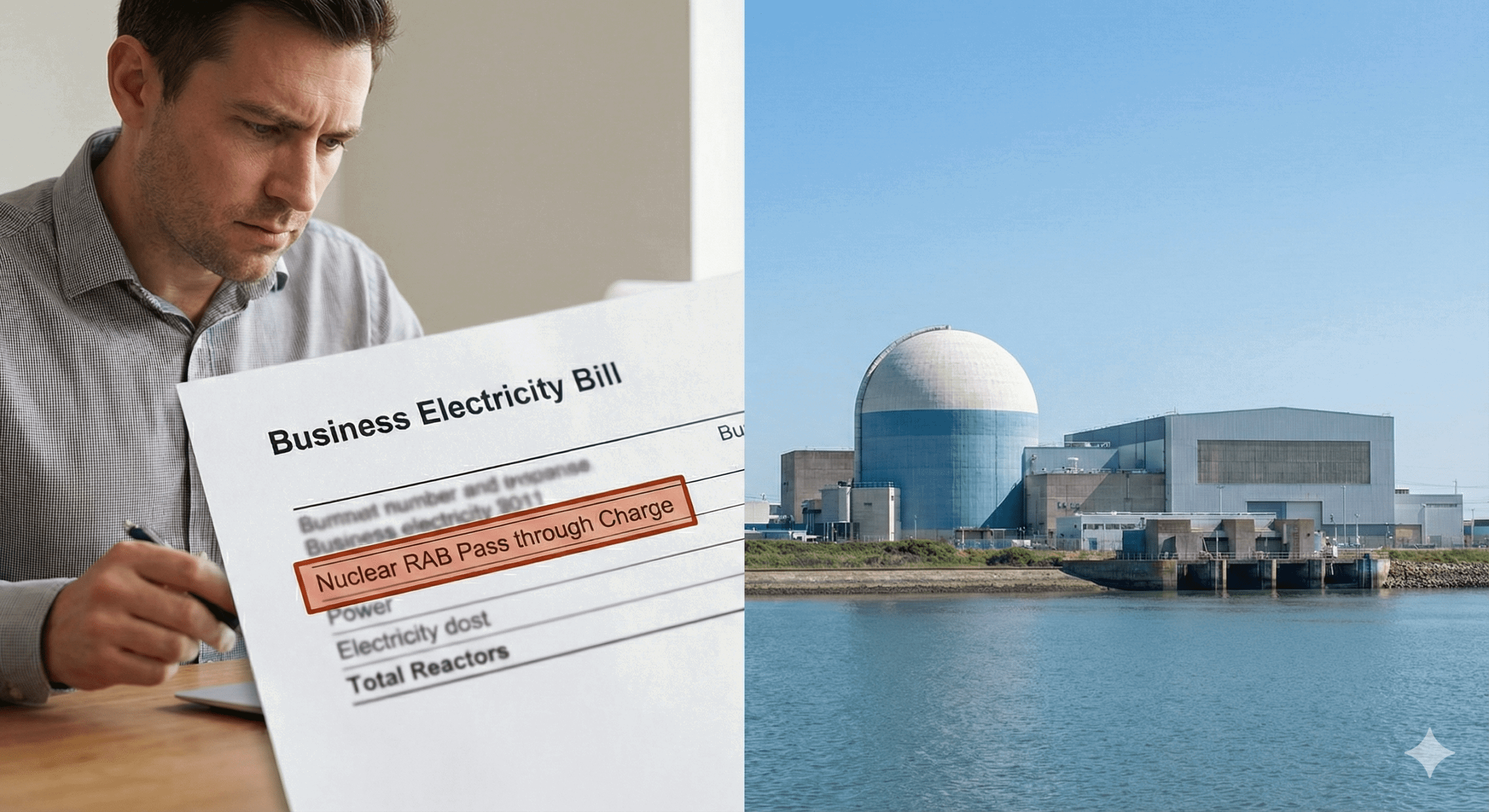
From 1 December 2025 many UK businesses are likely to notice a new line on their electricity invoices.
Nuclear RAB Pass through Charge.
It looks technical. It looks small. It still affects your costs.
This charge comes from a government decision to support new nuclear power stations through a Regulated Asset Base, or RAB, model. Instead of funding everything through future bills once a plant starts generating, part of the cost is recovered earlier through a small levy on current consumption.
For business owners already juggling wages, rent, taxes and existing energy costs, another line on the bill can feel like one thing too many. The aim here is simple. Give you a clear, steady explanation in plain English so you know what this charge means and how to factor it into your planning.
What Is The Nuclear RAB Pass Through Charge?
The Nuclear RAB Pass through Charge is a government mandated levy that suppliers add to electricity bills to support the construction of new nuclear projects, starting with Sizewell C.
Under the RAB model, nuclear developers receive a regulated income during the construction phase. Instead of bearing all the financing risk alone for many years, they share it with consumers through a small per unit charge on electricity use.
In practice that means:
-
The charge appears as a separate line on your electricity bill
-
It relates to a specific government mechanism, not a decision by your individual supplier
-
The money raised supports long term energy security and low carbon goals
You are not paying for a premium product or a value add service. You are contributing to a national infrastructure policy.
How Much Could It Cost Your Business?
The initial Nuclear RAB rate is set at 0.36p per kWh (which equals £3.455 per MWh in supplier language).
On the face of it, 0.36p looks tiny. The impact depends entirely on how much electricity your business uses.
Rough guide:
-
20,000 kWh per year – around £72 extra annually
-
40,000 kWh per year – around £144 extra annually
Larger users pay in proportion to their consumption. If your processes are electricity heavy, this line may turn into a noticeable figure over the course of a year.
For many smaller offices the charge may feel like background noise. For manufacturers, hospitality venues, leisure sites or multi site operations, it becomes one more pressure on already tight margins.
If I’ve Got A Fixed Contract In Place, Does The Nuclear RAB Charge Still Apply?
A common assumption goes like this.
“My rates are fixed, so new charges cannot be added.”
With the Nuclear RAB mechanism that assumption does not hold. Suppliers are legally required to apply the levy, so the charge appears as a separate pass through line even on fixed term contracts.
That distinction matters:
-
Your agreed unit rate for energy may stay fixed
-
The Nuclear RAB element sits on top, as a regulated additional cost
So a business that signed a competitive fixed deal before 1 December 2025 still sees this new charge on its bill once the mechanism starts.
Can You Avoid It By Switching Supplier?
Short answer in plain English. No, not in any meaningful way.
The Nuclear RAB Pass through Charge is set by government and applied across suppliers. It is not a marketing choice and not something one supplier can quietly drop to gain an advantage.
If you move from Supplier A to Supplier B:
-
Your core unit rates and standing charges may change
-
The Nuclear RAB line still appears, because both suppliers are subject to the same regime
Switching can still make sense for other reasons such as sharper core rates, better service or contract structure that suits your usage. It simply does not remove this specific line.
Who Might Be Exempt From The Nuclear RAB Charge?
There is a narrow doorway for relief.
Businesses that qualify under the Energy Intensive Industries (EII) exemption scheme do not pay this charge. The EII scheme is designed for sectors where electricity costs are a large share of overall expenses and where international competition is strong.
If you think your operation may sit in that bracket, the next steps usually look like this:
-
Check whether your sector appears on the latest EII eligibility lists
-
Review your electricity intensity compared to the criteria
-
Apply for an exemption certificate if you meet the thresholds
Without formal EII status, a business is treated as a standard non domestic customer and the Nuclear RAB levy applies.
Could The Rate Change Over Time?
The Nuclear RAB rate is not a one off figure that stays in place forever. It is reviewed regularly by the Low Carbon Contracts Company (LCCC).
Current forecasts suggest the rate could move to around 0.393p per kWh from January 2026, with possible seasonal variations after that. The pattern may shift as Sizewell C progresses and as other nuclear projects come into the frame.
In real terms that means:
-
The cost per kWh could rise gradually
-
The annual impact on your bill could grow in line with both your usage and any rate changes
For a business that tracks costs carefully, it makes sense to treat the Nuclear RAB line like any other regulated charge. You may not control the rate itself, but you can understand it, monitor it and adjust your plans.
What This Means For Your Energy Budget?
You already face a long list of items under “overheads”.
The Nuclear RAB Pass through Charge adds another moving part to your electricity costs. That does not mean panic. It does mean you gain from being deliberate.
Questions that help:
-
What is our current annual electricity consumption in kWh
-
At 0.36p per kWh, what extra spend does that create
-
How would a shift toward 0.393p per kWh change that figure
-
If we reduced usage by a modest percentage, what would that save across all charges, not just Nuclear RAB
Even small efficiency gains can chip away at multiple parts of the bill at once. They reduce unit charges, network costs, environmental levies and this nuclear line too, because everything ties back to consumption.
Practical Next Steps For Business Owners
If you do not want this new charge to catch you off guard, a simple short checklist often helps.
-
Pull your latest annual usage
-
Use recent invoices or annual statements
-
Note total kWh for each site
-
-
Estimate your Nuclear RAB cost
-
Multiply total kWh by 0.36p
-
Note what that looks like per month and per year
-
-
Stress test with a higher rate
-
Repeat the exercise at 0.393p per kWh
-
Treat this as a possible future scenario
-
-
Review your contract position
-
Check contract end dates and notice periods
-
Note whether you sit on a competitive fixed rate or a more expensive out of contract or deemed tariff
-
-
Look at efficiency opportunities
-
Simple behaviour changes and low cost upgrades often cut consumption
-
Larger investments need a proper cost benefit view, but many businesses leave easy wins on the table
-
None of this changes the existence of the Nuclear RAB Pass through Charge. It does change how exposed you are to it.
Where A Broker Fits In
For many owners and directors, time is the real scarce resource. Reading Ofgem documents or LCCC guidance comes far down the list after staff issues, customers, stock and cash flow.
This is where a specialist broker can add real value. A good broker:
-
Tracks regulatory changes such as the introduction of the Nuclear RAB charge
-
Translates policy decisions into clear, practical language for your specific type of business
-
Benchmarks your current rates against the wider market
-
Helps you line up contract decisions with known and likely changes in non energy charges
-
Guides you through questions such as EII eligibility and evidence gathering
Instead of reacting to the first bill that shows this new line, you move into the next contract cycle with your eyes open.
If your renewal date is coming up, or if you simply want a clear view of how the Nuclear RAB Pass through Charge affects your sites, a structured review of your bills and usage could be a very useful starting point.